
Empowering Stakeholders to Develop and Test a Flood Contingency Plan for Effective Flood Management


By Sylvester Afram Boadi, Prosper Bazaanah, Charlotte Norman, Frank Aggrey, Jacob Agyekum and Emmanuel Obuobie
In February/March 2024, twenty-nine stakeholders from fourteen institutions met for three days at Nandom, the capital of Nandom Municipality in the Upper West Region, for a stakeholder workshop aimed at building capacity for flood management in the Black Volta River Basin of Ghana. The workshop was convened by the Council for Scientific and Industrial Research – Water Research Institute (CSIR-WRI), in collaboration with the National Disaster Management Organization (NADMO) and the Water Resources Commission, with funding from the African Union and European Union Commissions through the GMES and Africa Programme Phase II and the “Sustainable Management of Wetlands and Floods for Strengthening Food Security and Ecosystem Resilience in West Africa – GDZHIAO” project. The stakeholders were drawn from varied institutions and included NADMO (regional, district personnel and zonal representatives), Water Resources Commission (Black Volta Basin Secretariat), Ghana Police Service, Ghana National Fire Service, Ghana Health Service, National Ambulance Service, Ghana Education Service, Information Services Department, District Planning Coordinating Unit, Red Cross, and representatives of 2 communities in the Nandom Municipality. Except for the community representatives, these stakeholders constitute NADMO’s structure for Municipal Disaster Management Committee (MDMC).
The capacity building engagement was organized in two parts: the first was collaborative development of a flood contingency plan (FCP) for the Nandom Municipality as no such plan existed, and the second was the simulation exercise to offer practical and hands-on experience of how to operationalize the FCP during a disaster. The development of the flood contingency plan began with a technical training session. In this session, the facilitators took the stakeholders through the technical aspects of flood contingency planning and management. This entailed discussions on key disaster risk reduction themes and concepts ranging from risk, exposure, vulnerability, and disaster to concepts on dealing with and responding to flood disasters (coordination, communication, and collaboration). This set the tone for the second session where the stakeholders were led to undertake a systematic identification of key vulnerabilities, assets and capacities available in the Nandom Municipality. Reflections from the discussions and exchanges that ensued in the session pointed to key learning around the role of collaboration before, during and after flood disasters among and between all the key stakeholders within the Nandom Municipality. The exercise on listing vulnerabilities, assets and capacities for example gave stakeholders deeper insight into the resources (financial, infrastructure, equipment, technologies, expertise, etc.) available to the stakeholder institutions for executing their mandates and how such resources can be re-tasked to support flood disaster prevention and mitigation. This session ended with a general realization among all stakeholders that NADMO-Nandom office has very limited resources for flood management and all key organizations must contribute to ensure effective flood management in the Municipality.
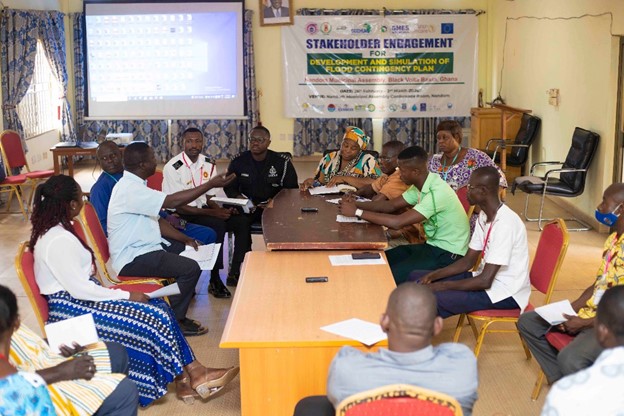
In the third session, the stakeholders were taken through NADMO’s structure for disaster management at the district level including how the structure works. This aspect of flood contingency planning was important as it paved the way for stakeholders to better understand what they are expected to do to ensure effective flood disaster management in the Nandom Municipality. Following this session, the stakeholders were put into 2 groups (see Figure 1) to undertake specific group tasks that were guided by NADMO’s template for developing a flood contingency plan. Outputs from the group works were compiled into a draft flood contingency plan for Nandom Municipality.

Break-out sessions on flood contingency plan development (Photo credit: Jacob Agyekum, CSIR-WRI)
The second part of the stakeholder engagement was the testing of the draft FCP in a table-top simulation exercise, alongside an orientation and learning for all stakeholders on what their roles are in the event of an actual flood. During the simulation exercise, the facilitators read out injects at specified intervals covering different timelines of the simulated flood event. Injects refer to new information, like details on an impending flood, unexpected complications, etc., that facilitators announce to test the stakeholders’ ability to respond to a crisis. The injects for this simulation exercise covered early warning information prior to the occurrence of the simulated flood event, specific data on rising water levels at different times during the simulated flood event, prompts for media briefings to keep citizens and stakeholders informed on the simulated flood, among others. During the simulation, the facilitators recorded the reactions, non-reactions, and decision-making of the stakeholders. At the end of the simulation, the exercise was assessed through a detailed independent debriefing and review session, leading to the identification of gaps in the draft flood contingency plan and the stakeholder decision-making process and actions. The stakeholders then outlined the need to meet post-workshop to revise the draft plan, conduct real field testing of the plan in the ensuing flood season before finalizing it for use by the Nandom Municipality. The workshop process reinforced that no single institution possesses all the resources or expertise required to manage flood disasters. Effective preparedness and response depend on strong coordination, communication, and collaboration among all key stakeholders, both governmental and non-governmental.
Dr. Sylvester Afram Boadi is a Geographer and Research Scientist with the Surface Water and Climate Change Division, CSIR-Water Research Institute, Accra-Ghana;
Dr. Prosper Bazaanah is a Social Scientist with the Surface Water and Climate Change Division, CSIR-Water Research Institute, Accra-Ghana;
Charlotte Norman is the Director for Climate Change Adaptation and Disaster Risk Reduction, National Disaster Management Organization, Accra-Ghana;
Frank Aggrey is the Deputy Director for Climate Change Adaptation and Disaster Risk Reduction, National Disaster Management Organization, Accra-Ghana;
Dr. Jacob Agyekum is a Climate Expert and Research Scientist with the Surface Water and Climate Change Division, CSIR-Water Research Institute, Accra-Ghana; and
Ing. Dr. Emmanuel Obuobie is a Hydrologist, Senior Research Scientist and Head of Surface Water and Climate Change Division at the CSIR-Water Research Institute.