
Unlocking Ghana’s Food Future: How Integrated Fish and Crop Farming Can Feed the Nation and Empower the Youth
Ghana faces a growing gap between the food needed and that produced as the population keeps growing. Fish remains a cornerstone of the Ghanaian diet, yet local production struggles to keep up with demand. Addressing this challenge requires moving away from low productive single-track fish farming methods. Speaking at the 2026 Mid-Year Review and the 30th-anniversary celebration of the CSIR-Water Research Institute (CSIR-WRI), Dr. Seth Koranteng Agyakwah outlined a game-changing solution: Integrated Aquaculture-Agriculture Systems (IAAS). By reconnecting food, water, health, and nature, this climate-smart approach tackles three (3) major national issues at once – food insecurity, environmental contamination, and youth unemployment.
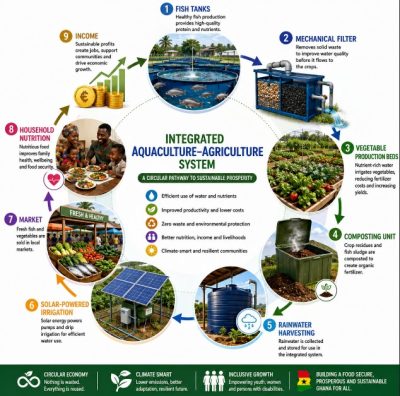
At first glance, raising fish in ponds or tanks and growing vegetables in soil may seem like two (2) completely separate activities. However, nature links them through a natural cycle of water and nutrient sharing. When farmers raise fish such as Nile tilapia or African catfish in culture systems such as earthen ponds and concrete tanks, uneaten feed and wastes released by the fish contaminate the water. In traditional setups, this water is discarded as pollutant that fouls nearby streams and rivers. In an integrated system, the useless fish culture water becomes “liquid gold”.
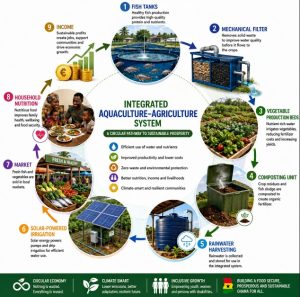
The Physical-Chemical Engine: Fish wastes, unconsumed feed, and biological by-products break down in the water, enriching it with nutrients like nitrogen and phosphorus. Instead of buying expensive chemical fertilizers, farmers can pump this nutrient-rich fish effluent directly onto crop beds.
The Biological Synergy: Plants act as natural filtration systems. Crop roots absorb nutrients available in water for vegetable growth, thereby cleaning and purifying the water. Regardless of using simple earthen ponds, backyard tanks, flow-through channels, or advanced aquaponics and recirculating aquaculture systems (RAS), the principle remains the same: transforming waste into wealth.
The Intersection of the Blue and Green Economy: Integrated farming bridges the Blue Economy (sustainable use of ocean and water resources) and the Green Economy (sustainable land-based production). Integration can therefore transform potential waste into a productive input and help farmers obtain greater value from limited land and water resources. The Mid-year review associated this approach with household food and income, improved nutrition and food security, climate-smart production, reduced environmental pollution through nutrient recycling and a more circular bioeconomy, thus creating a low-waste production model.
Climate-Smart Resilience: Maximizing yield per drop of water protects ecosystems from environmental degradation while lowering operational costs for farmers. By turning potential waste into valuable inputs, farmers may produce up to double the harvest- fish and vegetables, using the same drop of water and footprint of land. It is a cleaner, circular approach that saves money, protects natural water bodies, and builds resilience against changing weather patterns.
Proof of Concept: The ECOWAS–CORAF Youth Initiative
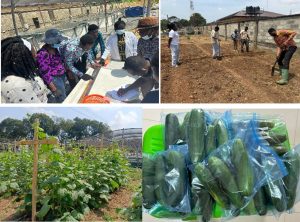
Dr. Agyakwah demonstrated that the integrated aquaculture-agriculture approach was more than just theory. He cited the example of the ECOWAS–CORAF Youth Employable Training Programme on Integrated Fish Farming Systems which was launched on March 12, 2026, at the CSIR-Water Research Institute, Accra. He reiterated that the practical training equipped young Ghanaian women and men with comprehensive technical and business development skills. The training package was modelled on four key strands, viz Aquaculture Regulatory Framework: (Governing laws, regulations and guidelines), Fish Production & Health (Fish biology of the Nile tilapia and African catfish, stocking, feeding, growth monitoring, hygiene, biosecurity, water quality monitoring and fish harvesting), Integrated Green Design (Analysing the soil, and building specialized vegetable beds and setting up irrigation lines connected directly to fish tank drains without the use of energy), Agribusiness Skills (Involving farm registration, risk management, record-keeping, financial analysis, marketing, and formal business plan development). At the end of the training, beneficiaries of the ECOWAS-CORAF Youth Employment Initiative harvested healthy African catfish alongside fresh cucumbers, selling both for increased household income.
Dr. Agyakwah emphasized that integrated farming is not a standard template that can be copy-pasted across every farm in Ghana. To succeed, every farm layout must be designed specifically for its location. According to him, some key local factors must be carefully mapped out before launching. These include: Environmental Factors (Soil quality and land topography, Local climate and water evaporation rates, Water availability and quality), and Operational Parameters (Water flow rates and irrigation methods, Input costs and local market demand, Specific crop and fish nutrient needs). He explained that customizing every site ensures high production yields, solid profit margins, and long-term environmental safety.
The Road Ahead: Financing and Government Support
Dr. Agyakwah re-echoed that while the scientific blueprint is clear and the youth are eager to work, significant hurdles remain, notably access to start-up capital. Learning to build a farm is only the first step. To turn business plans into thriving enterprises, young farmers require: Reliable starter packs and funding, Access to affordable suitable land and clean water resources, Quality farming inputs and constant technical support. He noted that, addressing these gaps requires political will, intentional planning, structured government backing, dedicated investment, and multi-stakeholder collaboration. By backing our young people with the right resources and climate-smart technologies, Ghana can turn wastewater into wealth, create sustainable jobs, and secure food independence for generations to come.
Authors: Ms. Adelina Akuamoah-Boateng, Dr. Rhoda Lims Diyie, Dr. Seth Koranteng Agyakwah (Research Scientists, CSIR-Water Research Institute, P.O. Box M32, Accra)