
Silent Killers: Why Resistant Infections in Ghana’s Elderly Care Homes Matter to Everyone
Dr. Edward J. Tettevi, Joel Otchere-Baffour, Emmanuel Odartei Armah
Adapted from the 2026 Mid-Year Review presentation by Mr. Emmanuel Odartei Armah, ARS (BPHRU/CSIR-WRI)
Imagine this: Your 78-year-old mother has become a resident at a care home in Accra. She’s settled in well – the staff are kind and she’s made friends. Then one morning, she develops a urinary tract infection (UTI) – an infection of the bladder, ureters or kidneys, most often caused by bacteria. Common. Treatable. Routine. The doctor prescribes antibiotics, but they’re ineffective. The infection worsens as the bacteria evolve, developing genes that render them resistant to almost every available antibiotic in the pharmacy. What should have been a routine treatment becomes a desperate fight for survival. This isn’t a hypothetical scenario; it’s happening right now in elderly care homes across Greater Accra.
Why the Elderly Are Vulnerable
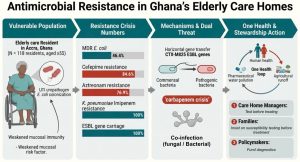
UTIs disproportionately affect elderly women due to weakened immunity, catheterization, and age-related anatomical and physiological changes. Declining mucosal immunity and postmenopausal microbiota shifts create a perfect storm for uropathogen (a microorganism that infects the urinary tract, such as E. coli) colonization. Chronic conditions and polypharmacy further increase risk. In Ghana’s care homes, these vulnerabilities are compounded by limited access to diagnostics and the absence of formal antimicrobial stewardship programs.
The Crisis in Numbers
Nearly half of urinary bacteria now resist standard medicines:
| Finding | Rate |
| Multidrug-resistant E. coli | 46.43% |
| Cefepime resistance | 84.6% |
| Aztreonam resistance | 76.9% |
| K. pneumoniae imipenem resistance (last resort) | 100% |
| ESBL gene carriage | 100% |
Source: BPHRU/CSIR-WRI, “Antimicrobial Resistance in Ghanaian Care Homes,” 2026. N = 118 residents aged ≥ 55 across facilities in Greater Accra.
Commensal bacteria, typically harmless, have become reservoirs of resistance harbouring genes that transfer to pathogenic (harmful/disease causing) strains through horizontal gene transfer. All 41 E. coli isolates tested carried ESBL (extended-spectrum beta-lactamase) genes – bacterial enzymes that inactivate most penicillins and cephalosporins – with 70.1% carrying four or more simultaneously. The predominant variant of CTX-M825 was found in this study population of elderly care home residents in Greater Accra.
The Carbapenem Crisis
Carbapenems are the final option for resistant infections. The study found 100% resistance in K. pneumoniae. When the last resort fails, pan-resistant strains emerge – infections with no known treatment. For elderly residents with weakened immune systems and chronic conditions, this is a potential death sentence. The implications are profound and demand urgent attention from the medical community and policymakers alike across the region.
The Antifungal Dimension
The study also identified 17 Candida pathogens (12 C. albicans, 5 C. tropicalis). Fluconazole (antifungal) resistance was high, particularly in C. tropicalis, which carries multiple virulence genes making it a competitive uropathogen. When first-line antifungals fail, alternatives are expensive and often unavailable in Ghanaian care homes. The antifungal crisis compounds the bacterial resistance crisis, creating a dual threat to vulnerable populations with limited treatment options in resource-constrained settings.
One Health Connection
The World Health Organisation’s Global Action Plan on Antimicrobial Resistance (2015) adopted a One Health approach recognising the interconnectedness of human and animal health within the food and agriculture system. Antimicrobial resistance transcends clinical boundaries, with environmental transmission increasingly recognised as a key dimension. The CSIR-WRI confirms that water contamination is a significant driver of this spread. Pharmaceutical residues, hospital wastewater, and agricultural runoff create breeding grounds for resistant organisms. This cycle is self-reinforcing as increased resistance leads to greater antibiotic use which in turn fosters further resistance.
“The continuous pollution of the country’s water bodies is an existential threat that required immediate national action,” stated Mr. Nunoo, Board Member, CSIR-WRI (2026).
The Stewardship Gap
Care homes currently prescribe antibiotics without susceptibility testing. No antifungal stewardship exists. Empirical treatment fails when resistance exceeds 50%. The solution requires coordinated action from managers, scientists, and policymakers working together effectively and urgently to address this growing public health crisis.
What You Can Do
Care Home Managers: Implement mandatory culture and sensitivity testing before prescribing antibiotics. Enforce strict hand hygiene protocols across all facilities.
Families: Ask if testing was done before treatment begins. Do not accept “just in case” prescribing without evidence of susceptibility data.
Policymakers: Fund diagnostic infrastructure and integrate LOCAL resistance data into national guidelines.
Authors:
All authors are affiliated to Water Research Institute of the Council for Scientific and Industrial Research (CSIR-WRI), Accra. Ghana
- Dr. Edward Jenner Tettevi is a researcher specializing in neurobiology, molecular genetics, and drug discovery. Email: ejtettevi@gmail.com, edward@csir.org.gh
- Mr. Joel Otchere-Baffour is a researcher specializing in information technology, computer programming, and data analytics. Email: j.otchere03@outlook.com
- Mr. Emmanuel Odartei Armah is a researcher specializing in microbiology, infectious disease, and global health. Email: emmanuelarmah44@yahoo.com