
-
September 23, 2026
- 0 Comment
Polluted Plates: How Microplastics Enter the Ghanaian Diet
By: Saada Mohammed, Humphrey Darko, and Pennante Naa Ayikailey Bruce-Vanderpuije
As part of the 2026 Mid-Year Review and the 30th Anniversary Celebrations of the CSIR-Water Research Institute (CSIR-WRI), findings from recent studies on microplastic pollution in Ghana’s aquatic environments were presented by Dr. Pennante Naa Ayikailey Bruce-Vanderpuije, Senior Research Scientist and Environmental Chemist at CSIR-WRI. The studies were conducted between 2021 and 2024 in selected locations within the Lower Volta Basin and along the Gulf of Guinea coast, including Jamestown, Labadi, and Teshie.
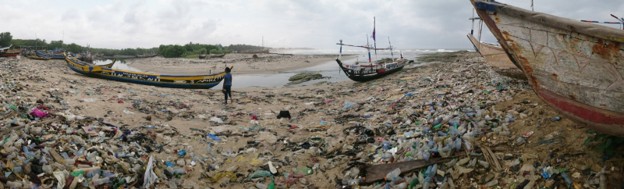
Microplastics are plastic particles smaller than 5 mm that originate from the fragmentation of larger plastic materials or from manufactured plastic products. They are now recognized globally as emerging contaminants because of their widespread occurrence in water, sediments, food organisms, and the atmosphere. In Ghana, increasing plastic consumption, inadequate waste management, littering, and the transport of plastic debris through rivers and drainage systems are important contributors to environmental microplastic pollution.
Fish were the focus of these studies because they contribute approximately 80% of the animal protein consumed in Ghana and therefore represent an important pathway through which people may be exposed to microplastics. Understanding the occurrence of microplastics in fish is therefore important for both food safety and public health.
In the Lower Volta Basin, researchers examined 330 fish representing 12 species, including cage-farmed tilapia and wild fish species. Microplastics, predominantly textile fibres, were detected in the gills and digestive tracts of both cultured and wild fish. The particles identified ranged from approximately 20–1000 µm, with fibres being the dominant form. Using established dietary exposure models and assuming regular consumption of fish organs containing microplastics, estimated annual exposures were approximately 3,000 particles for consumers of cage-farmed tilapia and 5,000 particles for consumers of wild fish.
It is important to note that these exposure estimates depend on consumption frequency and assume that the gills and digestive tracts are consumed. Individuals who remove these organs before cooking would be expected to have substantially lower exposure levels. Consequently, exposure estimates should be interpreted as scenario-based assessments rather than direct measures of actual intake for all consumers.
A separate study conducted along Ghana’s coast found considerably higher microplastic burdens in marine fish collected from Jamestown, Labadi, and Teshie. Estimated exposure levels ranged from approximately 31,000 to over 81,000 particles per year under regular fish-consumption scenarios. Unlike the Lower Volta Basin, where fibres dominated, coastal fish contained a greater proportion of films and polyvinyl chloride (PVC) particles, suggesting differences in pollution sources and environmental conditions between freshwater and marine ecosystems.
Microplastics can carry chemical additives and adsorbed contaminants that have been associated in laboratory and toxicological studies with inflammation, oxidative stress, and endocrine disruption. Some chemicals associated with plastics have also been classified as probable or possible carcinogens. However, a direct causal relationship between consumption of microplastic-contaminated fish and specific human diseases has not yet been conclusively established. Continued research is therefore needed to better understand long-term health implications.
The impacts of plastic pollution extend beyond food safety. According to Ghana’s Ministry of Environment, Science, Technology and Innovation (MESTI), plastic pollution imposes economic costs exceeding US$6 billion annually, equivalent to approximately 11% of national GDP, through flooding, blocked drainage systems, increased waste-management costs, and losses to tourism and fisheries. Encouragingly, a companion study found that approximately 85% of coastal residents were aware of the environmental risks associated with plastic pollution, while 78% expressed willingness to support mitigation efforts. These findings suggest that the primary challenge is not awareness but rather the availability of adequate waste-management infrastructure and effective enforcement of environmental regulations.
Addressing microplastic pollution in Ghana will require a combination of measures, including:
- Improved solid-waste collection and recycling systems;
- Reduction of single-use plastics, particularly sachet-water packaging and expanded polystyrene (Styrofoam);
- Enhanced drainage and waste-management infrastructure;
- Greater support for informal waste collectors and recyclers;
- Incorporation of microplastics into national food-safety and environmental monitoring programmes;
- Public education on responsible plastic disposal and reduction;
- Continued monitoring of microplastics in water, sediments, and fish.
Microplastic pollution in Ghana’s rivers and coastal waters represents a growing environmental and public-health concern. Protecting these ecosystems is essential not only for biodiversity conservation but also for safeguarding food security, human health, and the livelihoods of communities that depend on aquatic resources.
Food for Thought: If you knew how much plastic could enter the environment through everyday activities, would you change how you use and dispose of plastic products?
Ms Saada Mohammed is an analytical environmental chemist at the Water Research Institute of the Council for Scientific and Industrial Research (CSIR-WRI), Accra, Ghana. Email: saadaking@yahoo.com
Mr. Humphrey Darko is a water quality expert at the Water Research Institute of the Council for Scientific and Industrial Research (CSIR-WRI), Accra, Ghana. Email: darkohumphrey@gmail.com
Dr. Pennante Naa Ayikailey Bruce-Vanderpuije is an analytical environmental chemist at the Water Research Institute of the Council for Scientific and Industrial Research (CSIR-WRI), Accra, Ghana. Email: pennante@gmail.com