
Empowering Students for Climate-Resilient Water Management in Ghana
By: Sylvester Afram Boadi, Bismark Awinbire Akurugu, Jacob Agyekum, Martin Addi, Prosper Bazaanah, and Emmanuel Obuobie
Climate education is key to building stakeholder capacity for effective climate action. Currently, there are several on-going efforts by government and private actors in Ghana to improve climate literacy and build capacity of the citizenry for climate action. In line with such efforts and with support from Danida Fellowship Centre (DFC), the CSIR–Water Research Institute (CSIR-WRI) organised a series of Science Engagement under the theme “Empowering Students for Climate-Resilient Water Management in Ghana” in five selected Senior High Schools (SHSs) in the Pra and Densu River Basins. The Science Engagement activities, organised from Thursday 11th December to Monday 15th December 2025 on the campuses of the Senior High Schools, aimed at equipping students with knowledge, skills, and inspiration to become active stewards of Ghana’s water resources in a changing climate. Climate change is reshaping Ghana’s water future, with increasing floods, prolonged dry spells, rising temperatures, and declining groundwater threatening water security across the country. While these challenges are often discussed at policy and scientific levels, empowering young people to understand and respond to them is equally critical. Informed and empowered SHS students can drive solutions, so the Science Engagements series were to contribute to building climate-aware youth ready to lead sustainable and climate-resilient water management efforts.
Using scientific results from the Building Climate Resilience into Basin Water Management (CREAM) project, the series of engagements reached students from New Abirem/Afosu SHS, New Aperade Senior High/Technical School, and Adeiso Presbyterian SHS in the Eastern Region; Awutu Bawjiase SHS in the Central Region and T.I. Ahmadiyya Girls Senior High School in the Ashanti Region. Sessions began with interactive discussions clarifying the differences between weather, climate, and climate change, and how long-term shifts in temperature and rainfall affect daily life. Climate impacts such as floods, droughts, bushfires, and heatwaves, were discussed with a focus on the Pra and Densu Basins where changing conditions are already affecting water availability for households, agriculture, and industry.
The sessions also addressed how human activities, including waste dumping, agricultural chemical use, illegal mining (galamsey), and land degradation, compound climate pressures by further reducing water quality and availability. Students reflected on how everyday actions can either harm or protect water resources. A key message was that building climate-resilient water systems is a shared responsibility and requires collective action at all levels. Practical steps such as avoiding littering, conserving water, participating in clean-up exercises, and reporting pollution were discussed, alongside the role of scientists and institutions in monitoring water resources, advising government, and developing science-based solutions.
Importantly, students were introduced to career pathways in water, climate and environmental sciences, including hydrology, water engineering, Geographical Information System (GIS), and environmental science. Relevant study options in water, climate and environmental sciences and universities of study in Ghana, such as Kwame Nkrumah University of Science and Technology (KNUST), University of Ghana (UG), University of Energy and Natural Resources (UENR), and University of Cape Coast (UCC), were highlighted to inspire long-term interest in the sector. As a practical outcome, students were encouraged to form or strengthen Water and Environment Clubs in their schools. These clubs can serve as platforms for awareness creation, debates, clean-up activities, climate action, and sharing knowledge from water and climate research projects. By working together, students can become advocates for sustainable water management within their schools and communities.
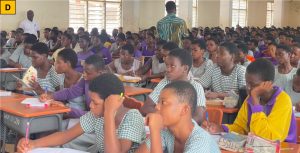
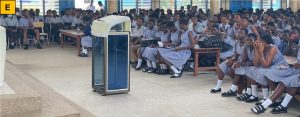
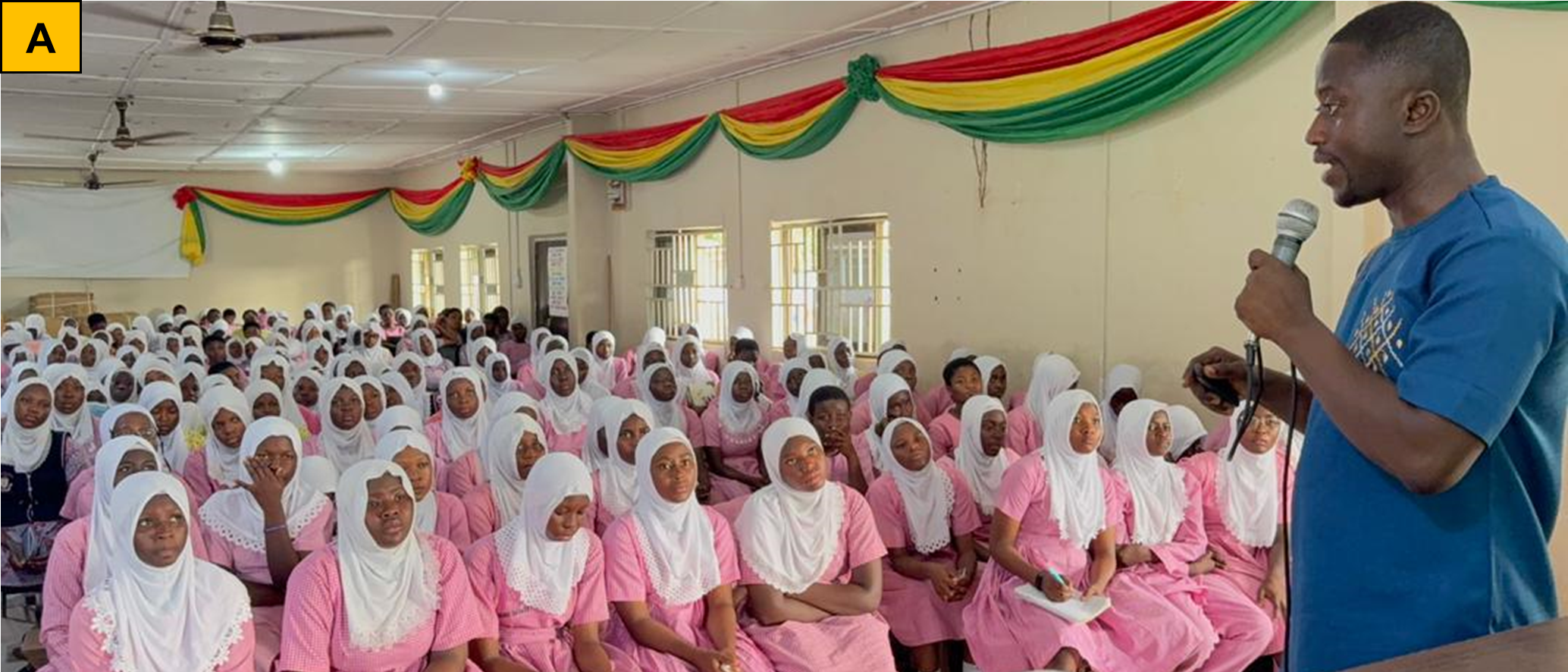
Image: Science engaging with students at (A) T.I. Ahmadiyya Girls Senior High School, (B) New Aperade Senior High/Technical School, (C) New Abirem/Afosu Senior High School, (D) Adeiso Presbyterian Senior High School, and (E) Awutu Bawjiase Senior High School.
Dr. Jacob Agyekum is a Climate Expert and Research Scientist with the Surface Water and Climate Change Division, CSIR-Water Research Institute, Accra-Ghana.
Dr. Sylvester Afram Boadi is a Geographer and Research Scientist with the Surface Water and Climate Change Division, CSIR-Water Research Institute, Accra-Ghana.
Dr. Bismark Awinbire Akurugu is an Assistant Research Scientist with the Groundwater and Geoscience Division, CSIR-Water Research Institute, Accra-Ghana.
Dr. Martin Addi is a Climate Expert and an Assistant Research Scientist at the Ghana Space Science and Technology Institute, Ghana Atomic Energy Commission, Accra, Ghana.
Dr. Prosper Bazaanah is a Social Scientist with the Surface Water and Climate Change Division, CSIR-Water Research Institute, Accra-Ghana.
Ing. Dr. Emmanuel Obuobie is a Hydrologist, Principal Research Scientist and Head of Surface Water and Climate Change Division at the CSIR-Water Research Institute.