
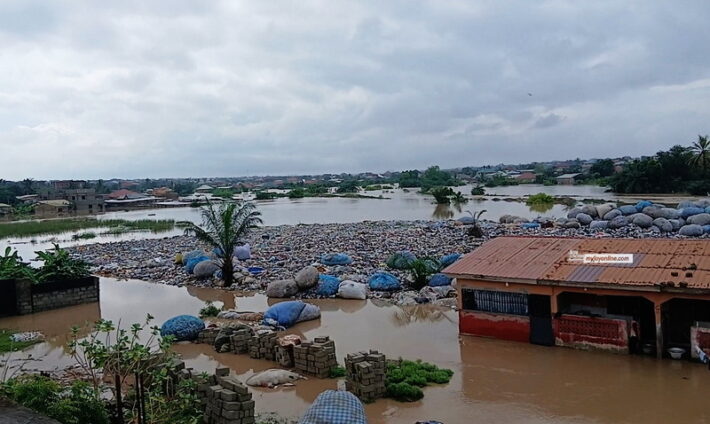
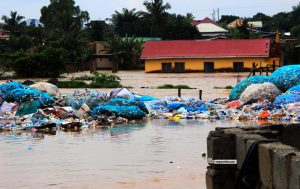
Illegal dumpsite washed into Weija Lake after floods, raising public health fears.
Mr. David Andoh (Joy FM) interviews Dr. Pennante Naa Ayikailey Bruce-Vanderpuije, Senior Research Scientist, Water Research Institute
A part of an unauthorised refuse landfill site, believed to contain an uncontrolled mix of municipal, industrial, and e-waste, including heavy metals like lead, cadmium, mercury, arsenic, and chromium, has been washed into the Weija Lake.
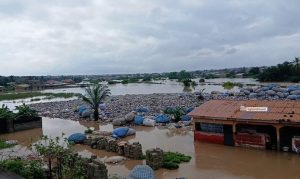
The illegal site, which was created along the banks of the River Jei at American Farm at Ngleshie Amanfro in the Ga South Municipality of the Greater Accra Region by an unknown property developer to fill the waterway for a commercial project, was swept into the Weija Lake by Wednesday’s devastating floods.
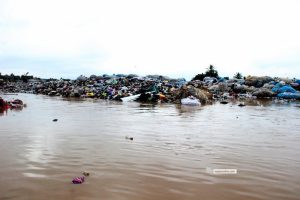
It now poses a grave danger to about 80% of Accra residents who rely on the water supply from the Weija Lake produced by the Ghana Water Company Limited. A large volume of plastic waste, including used sanitary pads, plastic bottled water containers and baby diapers, floated onto residents’ compounds, with an offensive smell that attracted swarms of flies and mosquitoes.
The Weija Lake, which serves as a source of drinking water for Accra West residents, is now raising serious environmental health concerns.
In an interview with myjoyonline, Dr. Naa Ayikailey Bruce-Vanderpuije, Senior Research Scientist at the Water Research Institute of Ghana, revealed that the uncontrolled mix of municipal, industrial and e-waste at the site likely released heavy metals like lead, cadmium, mercury, arsenic and chromium into the lake. Other contaminants include persistent organic pollutants such as PAHs from burnt waste and PCBs from electrical equipment, plus phthalates, BPA, faecal coliforms, E. coli, ammonia and hydrogen sulphide.
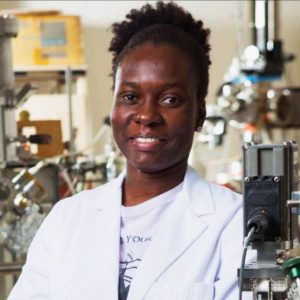
Faecal bacteria and ammonia are relatively short-lived, but heavy metals do not degrade,” Dr. Bruce-Vanderpuije explained. “They partition into bottom sediments within days and can remain bioavailable for decades. PAHs and PCBs bind strongly to organic particles and can persist in sediments for years to over a century.” She said the most immediate danger is microbiological contamination. “Faecal coliforms can cause acute gastroenteritis, typhoid, cholera and dysentery within hours to days.
Ammonia spikes also threaten aquatic life and can reduce disinfection efficacy. “The long-term risks, she added, are heavier. Lead causes irreversible neurodevelopmental damage in children at any level.
Cadmium accumulates in kidneys and causes progressive kidney disease. Arsenic is a known carcinogen linked to bladder, skin and lung cancers. PAHs and PCBs bioaccumulate in fish and pose cancer and endocrine disruption risks that will play out over decades if not fully remediated. Dr. Bruce-Vanderpuije urged GWCL and EPA to prioritise tests for total coliform, E. coli, turbidity, pH, dissolved oxygen, conductivity and ammonia. Within one week, a full heavy metal panel should be done.
Within 2-4 weeks, screening for PAHs, PCBs, phthalates and bioassay toxicity testing should be completed, with sediment cores taken near the inlet. “All results must be benchmarked against WHO drinking water guidelines and Ghana EPA/GSA standards, and published in full,” she said.
For the debris on the dam banks, she advised that it must be treated as hazardous waste until proven otherwise. Workers must use full PPE and waste must not be burned openly, as this creates dioxins and furans.
Material should go to a permitted landfill with leachate containment, and a temporary silt curtain should be deployed to intercept particles during future rains. Long-term health impact.
Children under five face the greatest risk from lead, with even low levels causing measurable IQ loss and behavioural problems. Pregnant women exposed to cadmium, mercury and organic pollutants risk preterm birth and foetal neurological impairment. Adults face increased cancer risk from arsenic and progressive kidney disease from cadmium. Policy gaps
Dr. Bruce-Vanderpuije said Ghana has laws like the Water Resources Commission Act, EPA Act and Public Health Act, but enforcement is failing.
There is no legally enforced boundary around Weija’s catchment, no national register of dump sites, and agencies like EPA, GWCL and District Assemblies work in silos. Fines for illegal dumping are also too low to deter offenders. She noted similar incidents have occurred before.
The Densu River, which feeds Weija, has faced over a decade of contamination from human activities and industrial discharge.
“My greatest concern is that heavy metals and persistent organic pollutants have already bound to lake sediments and will continue leaching into Accra’s water supply for months or years,” she said. “Residents should stop drinking tap water immediately and switch to verified bottled or sachet water from regulated sources until GWCL publishes independent lab results confirming the water meets WHO standards at the tap.
Water Research Institute conducts research into all aspects of water resources (both living and non-living) in order to provide scientific and technical information and services, as well as strategies for the sustainable development, utilization, and management of such resources for the socio-economic advancement of the country.
Source: David Andoh
https://www.myjoyonline.com/weija-lake-pollution-fears-as-floodwaters-wash-illegal-landfill-waste-into-water-source/