Our actions, their survival: The fate of aquatic animals
Future Africa Research Leadership Fellowship
Our water bodies are home to a countless number of animals of diverse sizes, from the unicellular amoeba to the largest animal on earth – the blue whale, each playing a role to keep their ecosystem in balance. They not only bring water bodies to life but also play a key role in global food security, serving as a major source of protein.
The importance of aquatic animals to world food security cannot be overemphasised. Human reliance on them for food has placed them in a vulnerable position of overexploitation to the point that some are on the verge of being wiped out from the earth. Aquatic animals need the right environment to flourish and provide the food we need. They need the right conditions to maintain their life cycles and keep their ecosystem in balance: the right temperature to trigger migration and reproduction. The health of their environment affects the success of their reproduction and, in some species, the number of offspring they produce. Their ability to flourish depends on the quality of the water they call home, and our commitment to allow them to flourish.
Threats
Aquatic animals are threatened by habitat degradation, fisheries bycatch, illegal wildlife trade, and overexploitation. Habitat degradation refers to any change in aquatic habitats that reduces their ability to support native organisms, caused by human activities. Climate change, coastal development, and pollution are major threats to the degradation of aquatic habitats. Increasing temperatures in aquatic environments caused by climate change disrupt the intrinsic clocks of aquatic animals, which control their life cycles. It may also have lethal effects as temperatures go above the tolerance levels of some species. The effects of lethal water temperatures on aquatic animals include direct mortality, metabolic collapse, and reduced oxygen availability. As the human population continues to grow, the need to meet human needs, such as shelter, increases. To meet these needs, we pour sand and gravel into the space where aquatic animals live to create a place of our own. This exposes human selfishness. Instead of being stewards, we look out only for ourselves, and only our comfort matters, taking over their space as coastal infrastructure development grows.
Some urban rivers that were once fishing grounds, brimming with aquatic life, have become large drains, dead zones, that can only boast of past glory. In the case of Ghana, once biodiversity hotspots, rivers mentioned with pride as major rivers of Ghana – Pra, Ankobra, Tano, Birim, and Offin with clear waters, and supporting fishing livelihoods, have now become a flowing liquid with colour that can best be described as ‘cocoa drink’ due to galamsy (illegal gold mining). Consuming fish from these rivers has become an efficient way of getting poisoned. Let us remember that when we pollute our water bodies, we put our lives at risk because what comes from them ends up on our tables.
Fisheries bycatch refers to non-target organisms that are caught in fishing nets. They are aquatic animals that get themselves into trouble for getting in the way, and most of the time, end up dying and being discarded. Fishing gears and methods pose varying degrees of bycatch threat to these animals, but the most feared and the most dangerous are the trawl and gillnet. While the trawl shows no selectivity in its operation, gillnet selectivity is zero when it catches by entanglement. Bycatch has biological, ecological and economic consequences, with a negative impact on food security. Most species of marine mammals, turtles, fish, and seabirds are affected, with thousands killed each year. This endangers their populations, driving some species to extinction. A few examples, according to the IUCN red list, include the Atlantic humpback dolphin (critically endangered), the Hawksbill turtle (critically endangered), the Golden skiffia fish (extinct in the wild), and the African penguin (critically endangered).
“The World Day of Aquatic Animals raises global awareness of the importance of all creatures that live in water. It aims to encourage people to learn about these animals and recognise their significance. Aquatic animals include not only fish but also molluscs, crustaceans, water birds, starfish, corals, aquatic insects, amphibians, marine mammals, reptiles, and more. The goal of the World Day of Aquatic Animals is to raise global awareness and establish principles, laws, education, and outreach efforts to protect these valuable creatures. The first World Day of Aquatic Animals in 2020 was celebrated by many organisations around the world, and it is hoped that more people will join in the coming years. The more people get involved, the better.” | Eco Calendar
Overexploitation of aquatic animals occurs when they are harvested at a rate exceeding their replenishment. This may happen through bycatch or through targeted fishing. The lack of alternative livelihoods among small-scale fishers in some developing countries, often shaped by culture, forces them to continue fishing even as fish resources decline. These fishers keep going back to the water with their gear, even when the catch they bring back keeps reducing day after day, a situation described as Malthusian overfishing. To keep their sinking livelihood afloat, these fishers may resort to unapproved fishing nets and destructive fishing methods such as dynamite fishing. When this happens, it is the fish stocks that get further depleted. Some species are victims of illegal wildlife trade. Though states enact laws to protect and conserve some threatened species, hunters secretly hunt them due to the economic value of some parts of their bodies or their flesh. A recent report ranked illegal wildlife trade as the fourth largest global illegal trade after narcotics, human trafficking, and counterfeit products. This undermines global conservation efforts.
What we can do
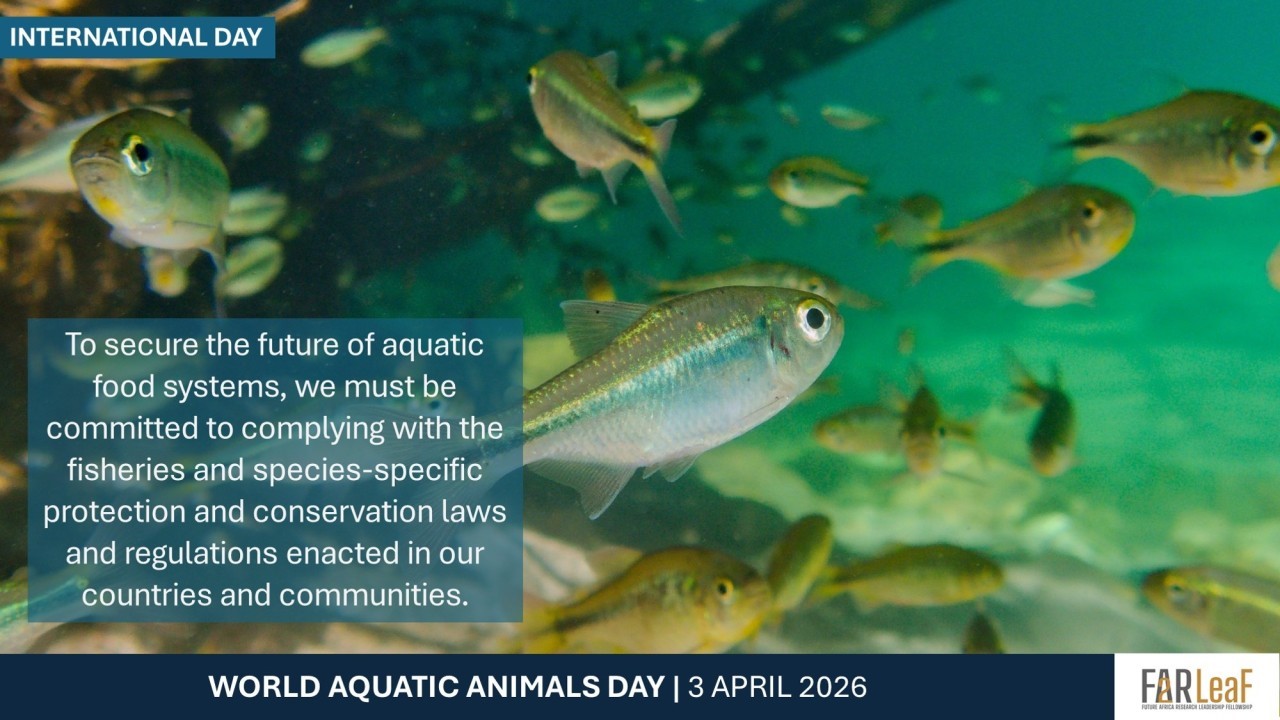
World Aquatic Animals Day is celebrated every year on 3 April. The theme for this year is The Human Gaze: Impacts on Aquatic Animals. Humans are solely responsible for protecting and conserving aquatic animals. When strategies, programs, and policies are formulated to manage aquatic animals, they actually manage the resource users. Aquatic animals only benefit from protection and conservation efforts when resource users comply. To secure the future of aquatic food systems, we must be committed to complying with the fisheries and species-specific protection and conservation laws and regulations enacted in our countries and communities. Before you connect your drainage pipe into that small stream, before you dump your waste at sea, pause and think about how your action will affect the animal life in that water space.
Moreover:
- Fishers should use ecologically friendly nets that have exclusion devices incorporated into the gear design to minimise bycatch and protect our threatened species.
- Small-scale fishers should comply with gear and mesh-size regulations and close seasons to allow fish populations to replenish.
- Water areas with high populations of threatened species should be designated as protected areas, and
- Nations should be committed to maintaining their Marine Protected Areas (MPAs) in effective condition.
As we develop the coastlines, let us respect the boundaries set by the Environmental Protection Authorities (EPAs). We must resist the temptation to turn our marshes into dry land by covering them with sand and gravel for infrastructure development. We can, together, help water bodies remain in better condition and offer a better home to aquatic animals if we decide to be true stewards of the environment. It just needs our commitment.
Dr Miriam Ameworwor is a Future Africa Research Leadership Fellow in the FAR-LeaF II programme, which focuses on future-looking science leadership and human capital development that aligns with the Carnegie Corporation’s interest in skills development, research, and retention for early-career researchers. Read more about her research project here: https://www.scienceblog.africa/fellows/dr-miriam-ameworwor